




Ball recirculating guides
Linear guides and precision carriages for every industrial need
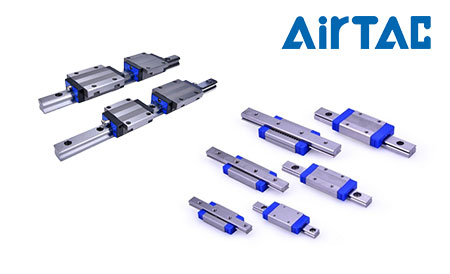
AirTac Linear Guides and Carriages: Reliability and Convenience for Industrial Automation
The AirTac linear guides and their associated carriages are designed to ensure constant smoothness, precision, and reliability in industrial automation applications. Thanks to their robust construction and optimized sliding technology, they reduce friction and wear, ensuring a long operational life with minimal maintenance.
Characterized by an excellent quality-price ratio, AirTac guides and carriages are ideal for assembly machines, handling systems, light automation systems, and numerous other industrial applications, offering a high-performing and cost-effective solution for every need.
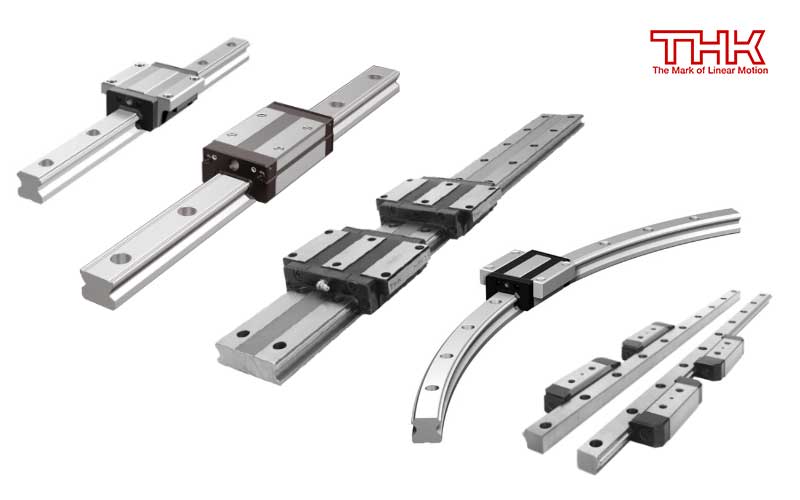
THK Linear Guides and Carriages: Precision, Durability, and Advanced Technology
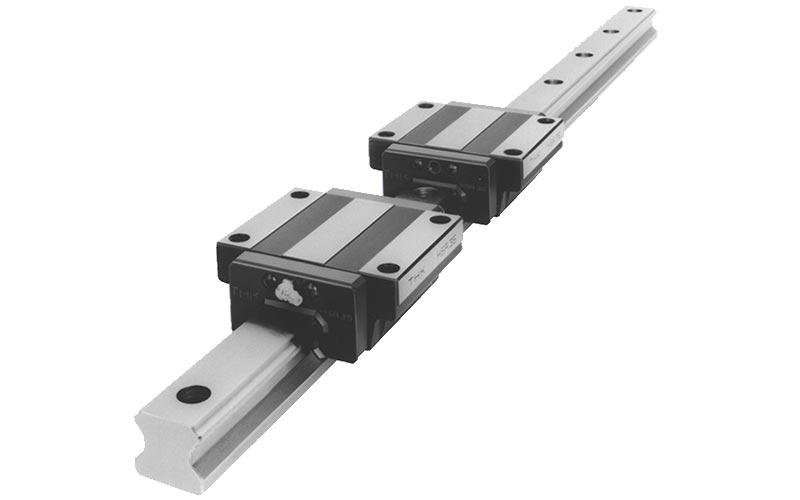
The THK linear guides and their corresponding carriages are the ideal solution for industrial applications that require high precision, reliability, and long-lasting performance. Thanks to the recirculating ball and caged roller technology, they offer smooth and quiet operation, reducing friction, wear, and maintenance needs.
Designed to withstand high loads and ensure consistent movement even in harsh conditions, THK guides and carriages provide stable performance and extended operational life. The quality of materials and THK technological innovation make them the perfect choice for machine tools, automation systems, robotics, and numerous other precision applications.
HSR Series
Ball recirculation technology
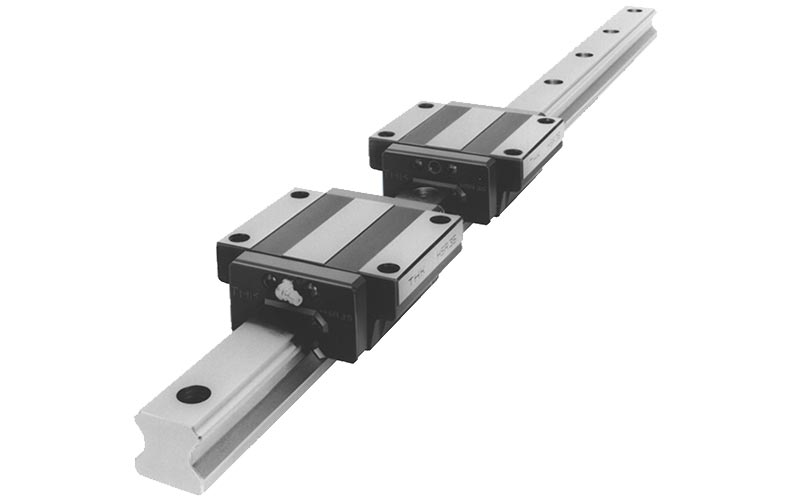
It is THK's historical guide and was the first four recirculation guide launched on the market. Thanks to the geometry of the track and the special support, the balls do not fall when the carriage is extracted from the guide. The balls roll on four precisely ground tracks located on the LM rail and within the carriage, where the recirculation ends, incorporated into the LM carriage, allow for ball recirculation.
Each ball series is positioned with a 45° contact angle so that the nominal loads applied to the LM carriage are uniform in all four directions (radial, reverse radial, and lateral), allowing the LM guide to be used in any orientation. Additionally, the LM carriage can receive a well-balanced preload, increasing rigidity in all four directions while maintaining a low and constant friction coefficient.
HSV Series
Ball recirculation technology
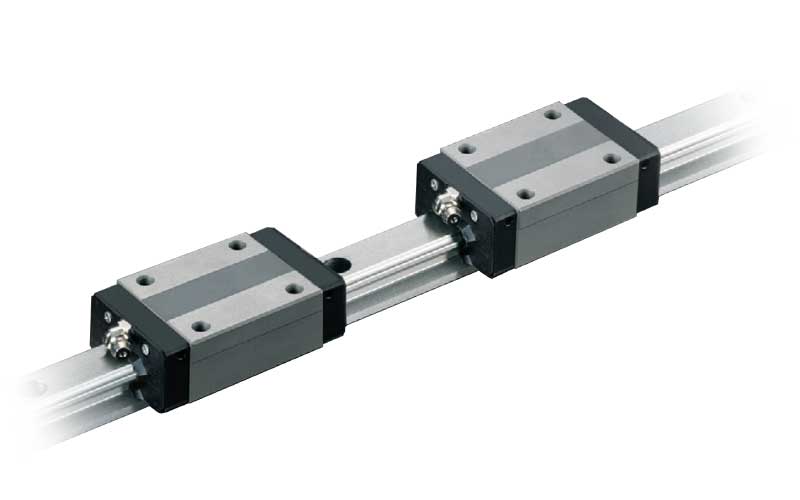
It is THK's historical guide and was the first four recirculation guide launched on the market. Thanks to the geometry of the track and the special support, the balls do not fall when the carriage is extracted from the guide. The balls roll on four precisely ground tracks located on the LM rail and within the carriage, where the recirculation ends, incorporated into the LM carriage, allow for ball recirculation.
The HSV series inherits the most important features of the more well-known HSR series. In this case, the four recirculating ball carriages slide on high-precision ground guides, are equipped with a ball retention system, and the structure of the recirculation ends ensures a smooth and silent movement.
Additionally, each row of balls is positioned at a 45° contact angle, making the nominal loads applied to the carriage uniform in all four directions (radial, reverse radial, and lateral) and allowing the guide to be used in any orientation. Their structural characteristics provide the guide with a significant ability to compensate for misalignment during installation that could affect the accuracy of the travel.
Regarding the HSV carriage, its compactness allows for high precision and homogeneous sliding, without forgetting that a well-balanced preload increases rigidity in all four directions while maintaining a constant and limited friction coefficient. Compactness is a factor that makes the HSV guide the ideal solution for applications where limited installation space is an important element for making the application itself.
Finally, the absence of differential slippage – even in the presence of preload or high partial loads – ensures that the motion remains fluid, resulting in the guide being particularly resistant to wear and thus allowing for prolonged machining cycles.
HCR Series
Ball recirculation technology
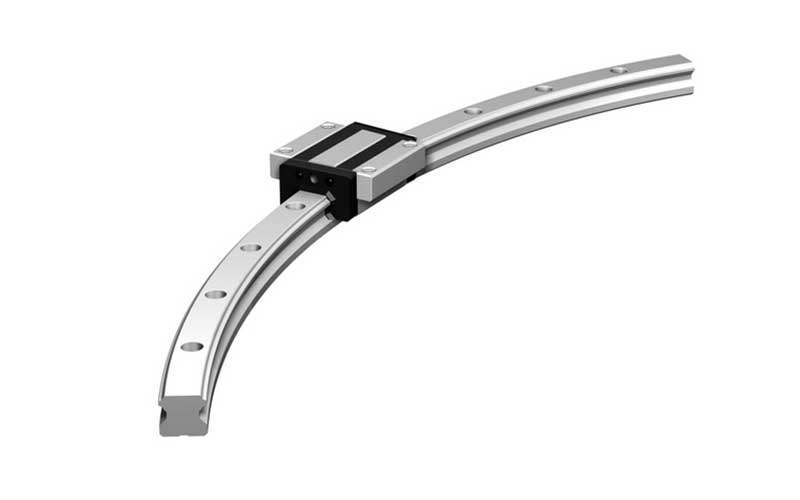
With a structure that is practically identical to that of the established HSR guide, with the same load capacity in all four directions, this circular guide is a new design that allows for very precise circular movement.
Multiple carriages can move individually on the same rail. Placing them at the load points results in an efficient structural design. This model allows for very precise circular movement, with no play, unlike sliding guides or roller guides. It can be assembled simply by mounting the rail and carriages with screws.
It allows for circular movement even on diameters of 5 meters or more, which is impossible with bearings. Furthermore, using this model simplifies the mounting, disassembly, and reassembly of the structure that moves circularly.
This model can accommodate loads in all directions thanks to its structure that is almost identical to that of the HSR model.
HRW Series
Ball recirculation technology
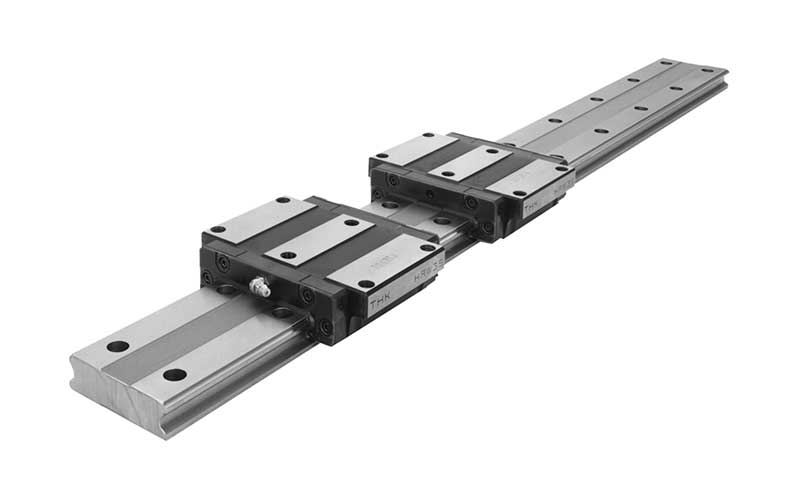
It is a low guide useful in applications where it is necessary to support high moments on the carriage.
Thanks to the geometry of the track and the special support, the balls do not fall when the carriage is extracted from the guide. The balls roll on four precisely ground tracks located on the LM rail and within the carriage, where the recirculation ends, incorporated into the LM carriage, allow for ball recirculation.
Each ball series is positioned with a 45° contact angle so that the nominal loads applied to the LM carriage are uniform in all four directions (radial, reverse radial, and lateral), allowing the LM guide to be used in any orientation. Additionally, the LM carriage can receive a well-balanced preload, increasing rigidity in all four directions while maintaining a low and constant friction coefficient.
HR Series
Ball recirculation technology
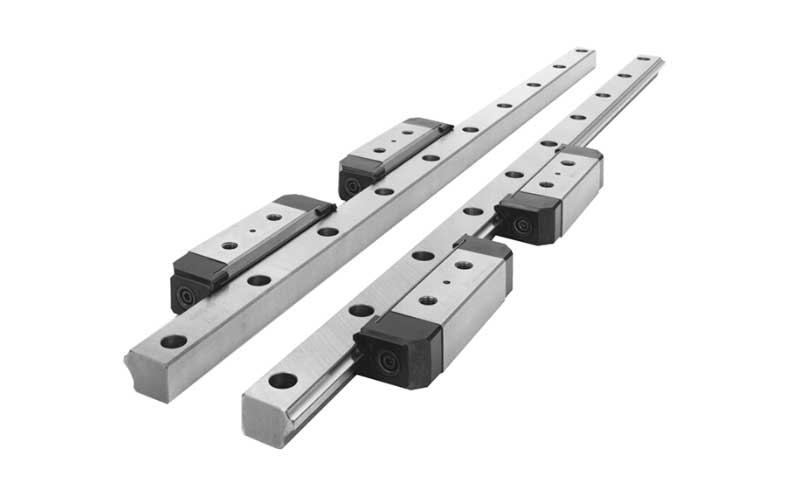
The HR guide is a newly designed product that allows for very precise circular movement.
Multiple carriages can move individually on the same rail. Placing them at the load points results in an efficient structural design. This model allows for very precise circular movement, with no play, unlike sliding guides or roller guides. It can be assembled simply by mounting the rail and carriages with screws.
It allows for circular movement even on diameters of 5 meters or more, which is impossible with bearings. Furthermore, using this model simplifies the mounting, disassembly, and reassembly of the structure that moves circularly.
This model can accommodate loads in all directions thanks to its structure that is almost identical to that of the HSR model.
NR Series
Ball recirculation technology
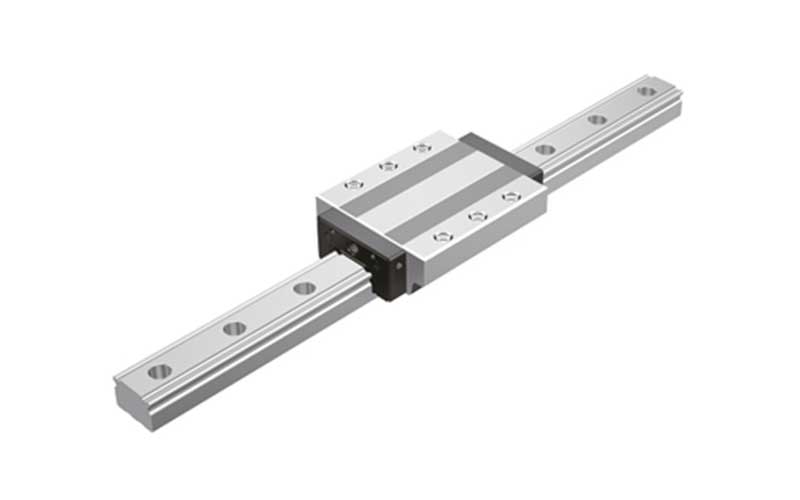
The NR guide model allows for heavy radial loads and is a product developed for the machine tool sector.
It has a very high load capacity and damping as well as high resistance to shocks and vibrations.
Compared to roller guides, it has a greater static load capacity despite its more compact structure.
The particular geometry of the rolling tracks of the balls allows this guide to better withstand radial loads compared to lateral ones.
HDR Series
Ball recirculation technology
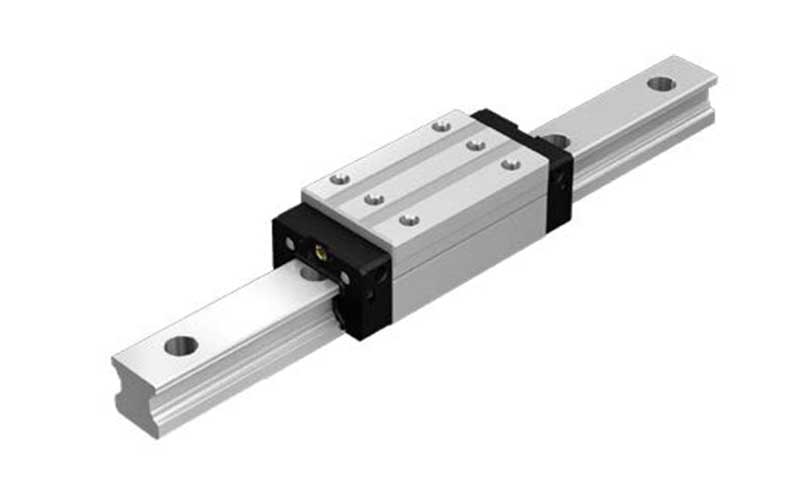
Ideal for applications with a single rail, the HDR model features a rigid design that can be used in systems designed with a single LM rail. It allows single-axis linear systems to be more compact and lightweight.
It is equipped with a ball contact structure with high rigidity in the Mc direction, making single-axis applications possible even when a moment is applied in that direction. The rolling tracks of the HDR model balls are arranged along the sides of the LM rail, making it difficult for foreign bodies to deposit on them. To use the product more effectively, cover plates can also be installed, further improving contamination protection performance.
The HDR model is equipped with a range of interchangeable carriages and LM rails that can be freely combined as long as they are of the same size.
HRX Series
Ball recirculation technology
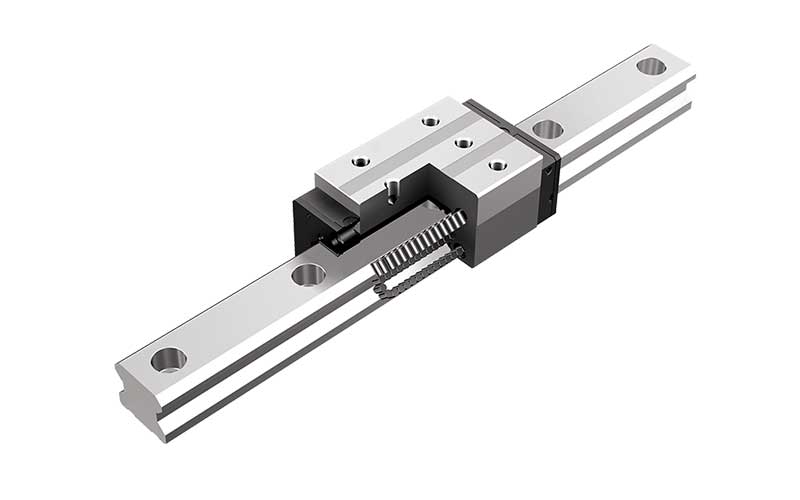
HRX is an LM guide that uses rollers as the rolling element for greater rigidity.
On the HRX, each row of rollers is arranged with a 45° contact angle so that the LM block receives an equal load coefficient in all directions (radial, reverse radial, and horizontal), ensuring high rigidity in all directions.
The HRX range features interchangeable products capable of meeting specifications by freely combining LM blocks and LM rails with the same model number.
Other models
Ball recirculation technology
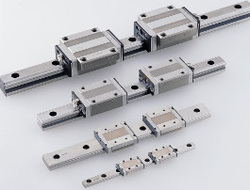
The telescopic guide is a low-cost linear guide with limited stroke, made from precision machined steel sheet through rolling.
Thin, compact, and easy to install, this product is suitable for numerous applications requiring linear guides.
It is a new product specialized in the handling of components for furniture with lightweight characteristics and compact dimensions.
THK Linear Guides - Special Environments
THK Linear Guides - Vacuum Applications
THK Linear Guides - High Temperature Applications
THK Linear Guides - Corrosive Environment Applications
THK was the first manufacturer in the world to launch linear guides with caged balls on the market.
This technology eliminates collisions between the balls and maintains a lubricant film between each ball, significantly extending the required lubrication intervals.
It also drastically reduces noise and increases the maximum allowable translation speeds.
SSR Series
Caged ball recirculation technology
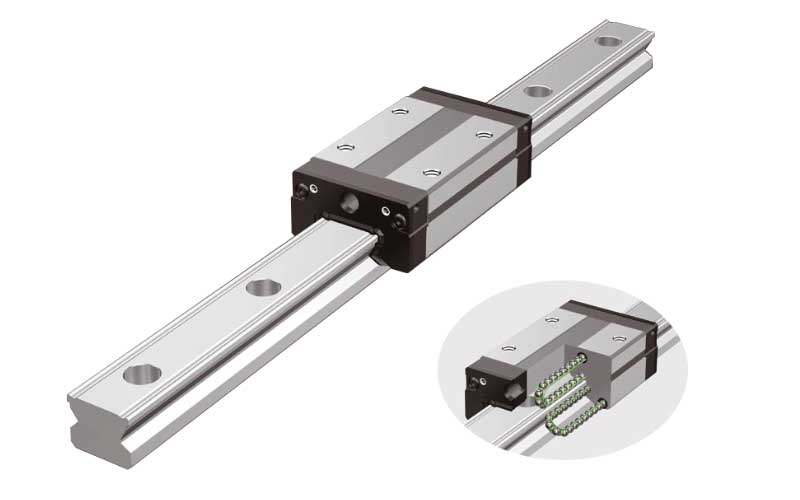
It is THK's historical guide and was the first four recirculation guide launched on the market. Thanks to the geometry of the track and the special support, the balls do not fall when the carriage is extracted from the guide. The balls roll on four precisely ground tracks located on the LM rail and within the carriage, where the recirculation ends, incorporated into the LM carriage, allow for ball recirculation.
Each ball series is positioned with a 45° contact angle so that the nominal loads applied to the LM carriage are uniform in all four directions (radial, reverse radial, and lateral), allowing the LM guide to be used in any orientation. Additionally, the LM carriage can receive a well-balanced preload, increasing rigidity in all four directions while maintaining a low and constant friction coefficient.
SHS Series
Caged ball recirculation technology
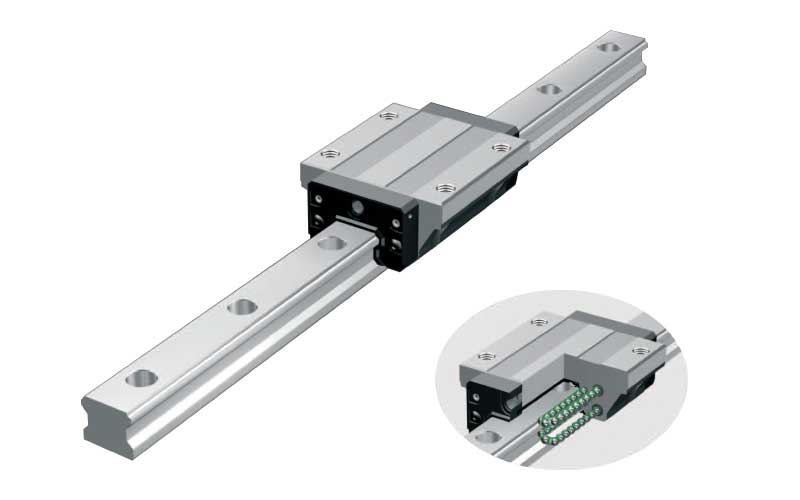
Thanks to the track geometry, caging, and special support, the balls do not fall when the carriage is extracted from the guide. The balls roll on four precisely ground tracks located on the LM rail and within the carriage, where the recirculation ends, incorporated into the LM carriage, allow for ball recirculation.
Each ball series is positioned with a 45° contact angle so that the nominal loads applied to the LM carriage are uniform in all four directions (radial, reverse radial, and lateral), allowing the LM guide to be used in any orientation.
Additionally, the LM carriage can receive a well-balanced preload, increasing rigidity in all four directions while maintaining a low and constant friction coefficient.
SHW Series
Caged ball recirculation technology
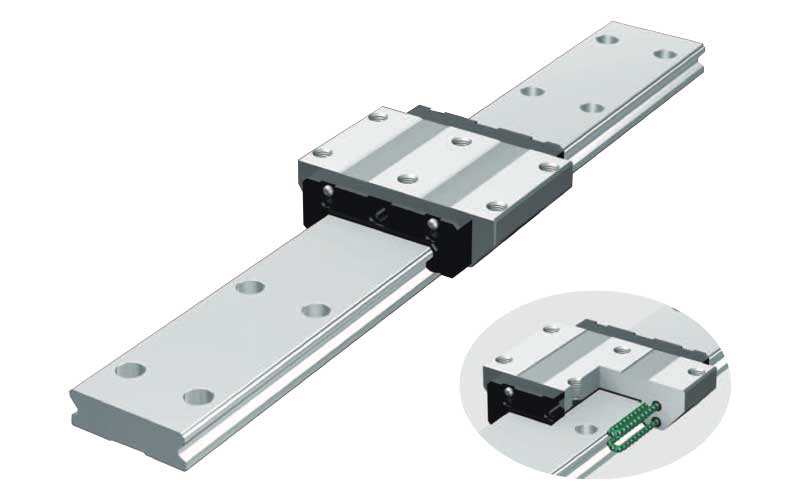
This model has the characteristic of being low and wide to withstand high moments in the direction perpendicular to the rail. It has crossed 45° ball contact that allows for equal load capacity in all directions.
The SHW model, which features a wide LM rail and a lowered center of gravity, is optimal for applications requiring space savings and high rigidity in the Mc moment direction. Each ball series operates with a 45° contact angle so that the loads applied to the LM carriage are uniform in all four directions (radial, reverse radial, and lateral), allowing the LM guide to be used in any orientation for wide applications.
The self-aligning capability, thanks to the face-to-face configuration of THK's unique circular arc tracks (DF configuration), allows for the absorption of mounting error even with preload, thus obtaining linear, uniform, and very precise movement.
The use of cages eliminates friction between the balls and retains the lubricant, allowing for low production of micro-pollutant particles.
SPR/SPS Series
Caged ball recirculation technology
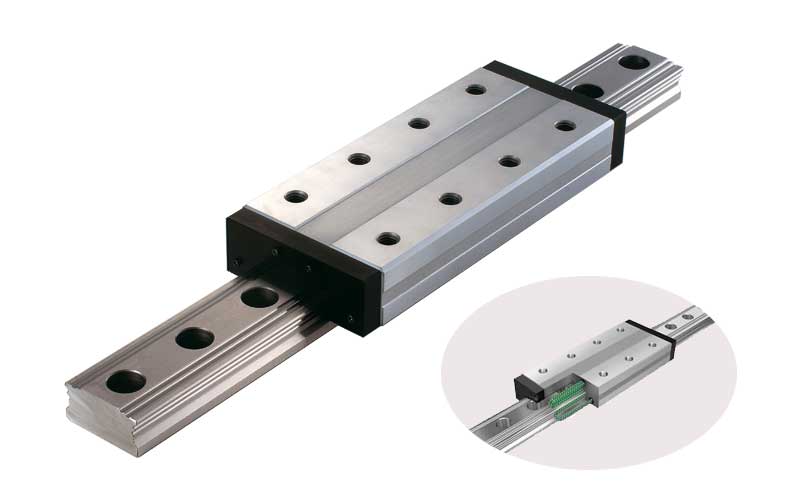
This type of advanced LM guide achieves extremely low waves and extremely high rigidity by adopting 8 rows of tracks in the guide.
These models adopt 8 rows of tracks, small diameter balls, and super-long blocks to achieve very low waves and ultra-high rigidity that exceed conventional LM guides. With this approach, the number of actual balls is substantially increased and the width of the moving rolling element is minimized.
These new models are comparable to hydrostatic guides; the deformation of the ball is minimized to achieve extremely high rigidity that even exceeds roller guides, contributing to greater precision in equipment.
The SPR/SPS models can accommodate loads in all four directions: radial, reverse radial, and lateral.
SRG/SRN Series
Caged ball recirculation technology
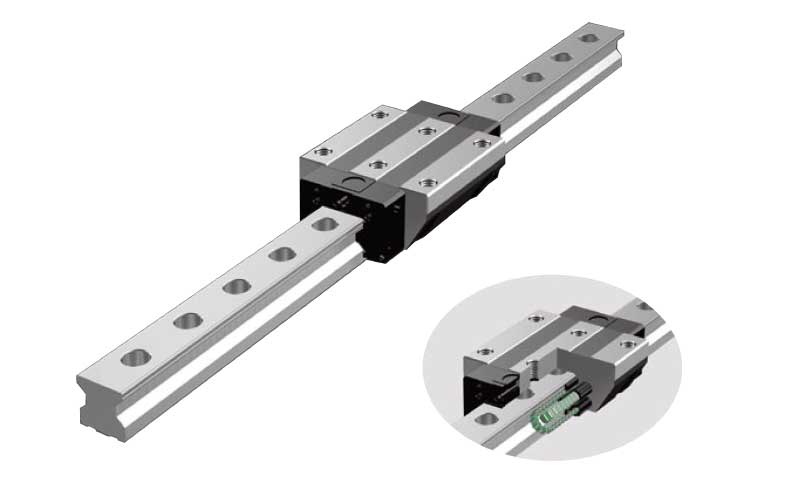
The SRG and SRN models are ultra-rigid roller guides that employ roller cages to allow for low friction, smooth movement, and achieve maintenance-free long-term operation.
These models adopt 8 rows of tracks, small diameter balls, and super-long blocks to achieve very low waves and ultra-high rigidity that surpass conventional LM guides. With this approach, the number of actual balls is substantially increased and the width of the moving rolling element is minimized.
These models achieve extremely high rigidity by using rollers as the rolling elements, as they are less subject to deformation and have a total length 1.5 times greater than their diameter. Each ball series is positioned at a 45° contact angle so that the LM carriage receives the same load in all four directions (radial, reverse radial, and lateral), ensuring high rigidity in every direction.
The use of roller cages eliminates friction between them and increases grease retention, allowing for maintenance-free operation for an extended period.
SRW Series
Caged ball recirculation technology
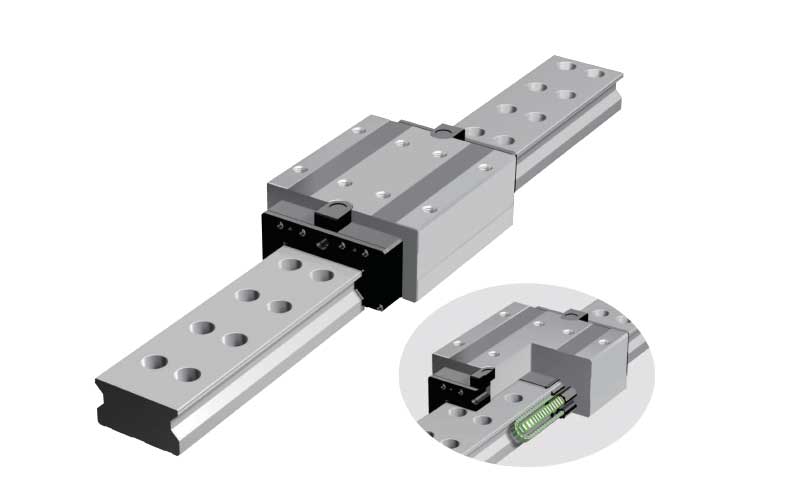
The SRW model, based on the roller guide with cage technology of the SRG model, has a wider guide and two rows of mounting holes for LM guide to achieve high mounting strength and stability.
The use of roller cages allows for low friction and smooth movement. Therefore, the SRW model is an extremely rigid roller guide that allows for maintenance-free long-term operation.
As it has a wide guide that can be fixed to the table using the two rows of mounting bolts, the resistance is significantly increased. Additionally, as the distance of the transverse track is wide, the SRW model is structurally strong for a transient load (moment MC) in the rolling direction.
SRS Series
Caged ball recirculation technology
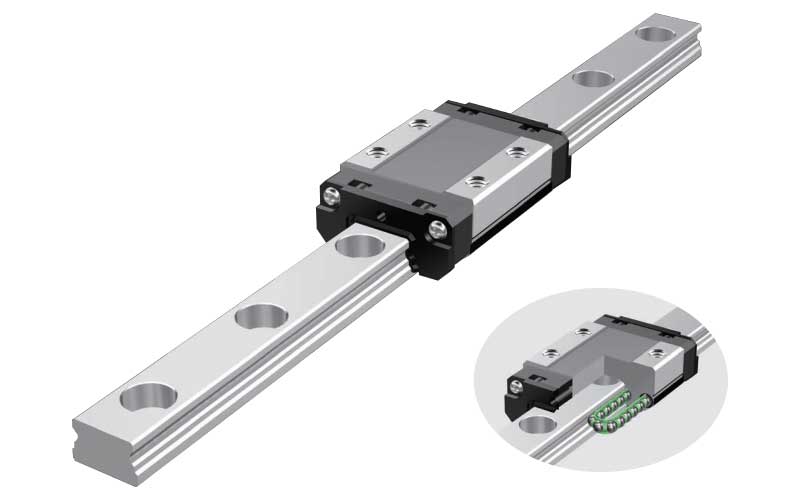
It is THK's historical guide and was the first four recirculation guide launched on the market. Thanks to the geometry of the track and the special support, the balls do not fall when the carriage is extracted from the guide. The balls roll on four precisely ground tracks located on the LM rail and within the carriage, where the recirculation ends, incorporated into the LM carriage, allow for ball recirculation.
Each ball series is positioned with a 45° contact angle so that the nominal loads applied to the LM carriage are uniform in all four directions (radial, reverse radial, and lateral), allowing the LM guide to be used in any orientation. Additionally, the LM carriage can receive a well-balanced preload, increasing rigidity in all four directions while maintaining a low and constant friction coefficient.
EPF Series
Ball recirculation technology
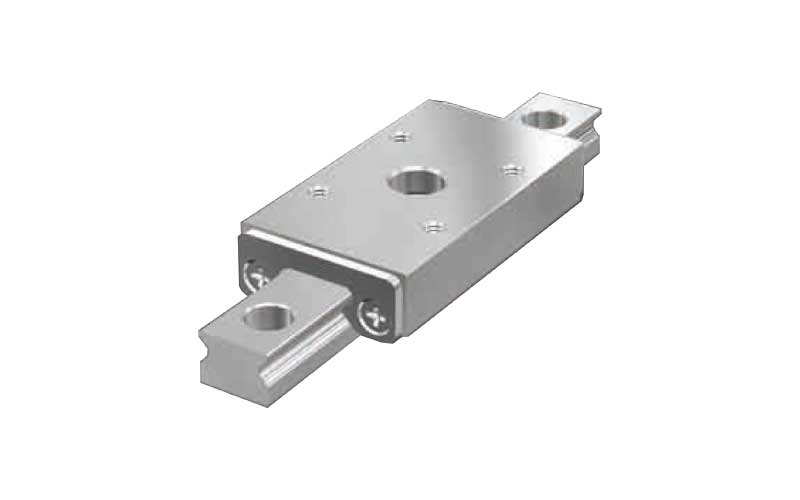
Thanks to the geometry of the track, caging, and special support, the balls do not fall when the carriage is extracted from the guide. The balls roll on four precisely ground tracks located on the LM rail and within the carriage, where the recirculation ends, incorporated into the LM carriage, allow for ball recirculation.
Each ball series is positioned with a 45° contact angle so that the nominal loads applied to the LM carriage are uniform in all four directions (radial, reverse radial, and lateral), allowing the LM guide to be used in any orientation.
Additionally, the LM carriage can receive a well-balanced preload, increasing rigidity in all four directions while maintaining a low and constant friction coefficient.
RSR3 Series
Ball recirculation technology
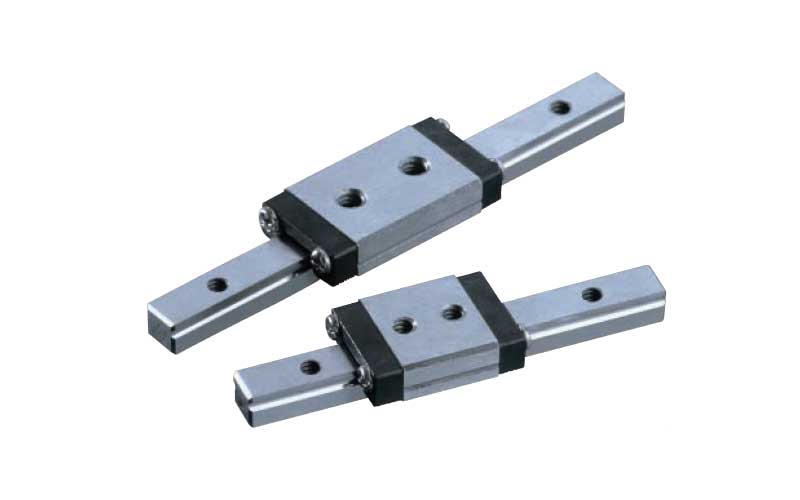
This model has the characteristic of being low and wide to withstand high moments in the direction perpendicular to the rail. It has crossed 45° ball contact that allows for equal load capacity in all directions.
The SHW model, which features a wide LM rail and a lowered center of gravity, is optimal for applications requiring space savings and high rigidity in the Mc moment direction. Each ball series operates with a 45° contact angle so that the loads applied to the LM carriage are uniform in all four directions (radial, reverse radial, and lateral), allowing the LM guide to be used in any orientation for wide applications.
The self-aligning capability, thanks to the face-to-face configuration of THK's unique circular arc tracks (DF configuration), allows for the absorption of mounting error even with preload, thus obtaining linear, uniform, and very precise movement.
The use of cages eliminates friction between the balls and retains the lubricant, allowing for low production of micro-pollutant particles.
Filters
Filters
Subscribe to the Newsletter
Product and service news, tips, and other benefits: it's worth subscribing!

Quick quote
Even if they aren't listed on our website, we probably have the spare parts you're looking for. Let us know the quantities and we'll send you our quote!