




Asynchronous Motors
Three-phase and single-phase Induction Motors, efficiency and reliability
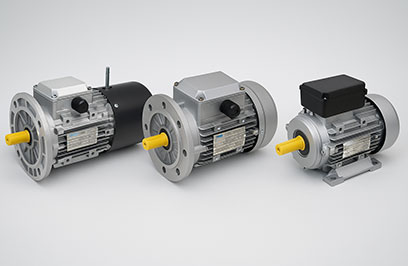
A wide range of single-phase and three-phase asynchronous motors, available with or without brake, in various sizes and constructions, robust and reliable, are suitable for every type of application.
Typically, the identification of an electric motor is determined by its rated characteristics:
- power, voltage, and frequency
- speed (number of poles or revolutions per minute)
- construction (type of mechanical mounting of the flange and/or feet)
For example: Motor 0.75kW - 4 poles (1400rpm) - B5 - 230V/400V/50Hz
Electric motors are also classified by energy efficiency classes, called IE (International Efficiency) followed by a progressive number that indicates the level of efficiency, as required by European regulation CE No.640/2009.
From July 1, 2021, EU Regulation 2019/1781, supplemented by
EU Regulation 2021/341, mandates minimum energy efficiency requirements for
low-voltage asynchronous motors (0.12 – 1000 kW) and for variable speed drives (VSD).
Three-phase motors with power between 0.75 and 1000 kW must be at least
IE3 (Premium Efficiency), while three-phase motors between 0.12 and 0.75 kW and single-phase motors
of ≥ 0.12 kW must meet the IE2 class.
From July 1, 2023, an update requires three-phase motors from
75 to 200 kW (2‑4‑6 poles, excluding EX eb models, self-braking, etc.) to achieve at least
the IE4 (Super Premium Efficiency) class.
Single-phase motors of ≥ 0.12 kW remain subject to IE2, and
ATEX motors must meet the same efficiency thresholds as non-Ex versions.
The IE (International Efficiency) classes are defined according to standards
IEC 60034‑30‑1 (IE classification) and IEC 60034‑2‑1 (test methods).
The regulation also requires indicating on the nameplate and technical documentation the motor's efficiency
at different loads and speeds, to enable better selection of the overall motor-drive system.
For the period 2025–2029, the regulation will remain in effect for motors placed on the European market by the specified deadlines, while the European Commission has initiated a comprehensive review of the regulatory framework (Ecodesign for Sustainable Products – ESPR), which may introduce new specifications, digital labeling and repairability requirements.

Filters
Filters


Frequently asked questions
What efficiency class must a three-phase electric motor sold in Europe have?
The EU Regulation 2019/1781 establishes the minimum energy efficiency requirements for various types of electric motors placed on the European market.
From July 1, 2023, the following requirements are expected for three-phase motors that fall within the scope of the regulation:
- IE2 for powers from 0.12 kW to less than 0.75 kW.
- IE3 for powers from 0.75 kW to 1,000 kW.
- IE4 for certain types of three-phase motors from 75 to 200 kW, with 2, 4, or 6 poles.
The regulation provides for conditions of applicability and exclusions for specific types of motors. For this reason, the required efficiency class must be assessed based on the characteristics of the individual product and its intended use.
To choose the most suitable motor, it is important to verify the technical data listed in the product sheet.
Check the Asynchronous Motors category in the ATTI catalog.
What is a self-braking motor and when is it needed?
The self-braking motor is an electric motor equipped with a built-in brake that, in normally braked versions, locks the shaft when the power supply is interrupted.
It is used in applications where it is necessary to quickly stop movement or hold a load with the motor off, for example:
- Lifting systems, to help keep the load in position.
- Inclined conveyor belts, to prevent unwanted movements.
- Translational systems, when controlled stopping is required.
- Industrial machines, where it is necessary to maintain a position with the motor off.
ATTI offers self-braking three-phase asynchronous motors in various sizes and construction types.
To choose the correct model, it is important to verify the power, braking torque, power supply voltage, and application characteristics.
Consult the Asynchronous Motors category in the ATTI catalog.
Subscribe to the Newsletter
Product and service news, tips, and other benefits: it's worth subscribing!

Quick quote
Even if they aren't listed on our website, we probably have the spare parts you're looking for. Let us know the quantities and we'll send you our quote!