




Ball Recirculating Screws
THK Screws and Shafts, precision and reliability
The ball screw is a precision mechanical system in which, between the threaded shaft and the threaded nut with a concave thread, steel balls are inserted that move in a helical groove. These balls serve to convert sliding friction into rolling friction, reducing energy losses and improving efficiency. The helical groove, with a hemispherical section, maintains the same pitch as the screw but with a slightly larger mean diameter, allowing for smooth and stable movement.
This is the most widespread mechanism for converting rotary motion into linear motion, considered to be the evolution of the traditional screw-nut: it offers greater precision, long life, and a high efficiency (approximately 90%).
THK designs and manufactures a complete range of ball screws, available both with “Caged Ball” technology, which reduces friction and noise, and with the traditional full nut technology.
Alongside these, the range also includes BNS precision spline shafts, which integrate rotary and linear motion into a single component, offering a compact and extremely efficient solution for numerous industrial applications.
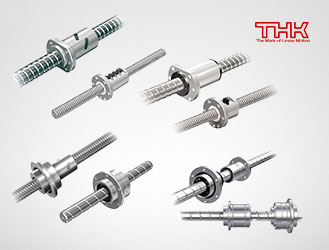
Series EBB/EPB
Ball Screw
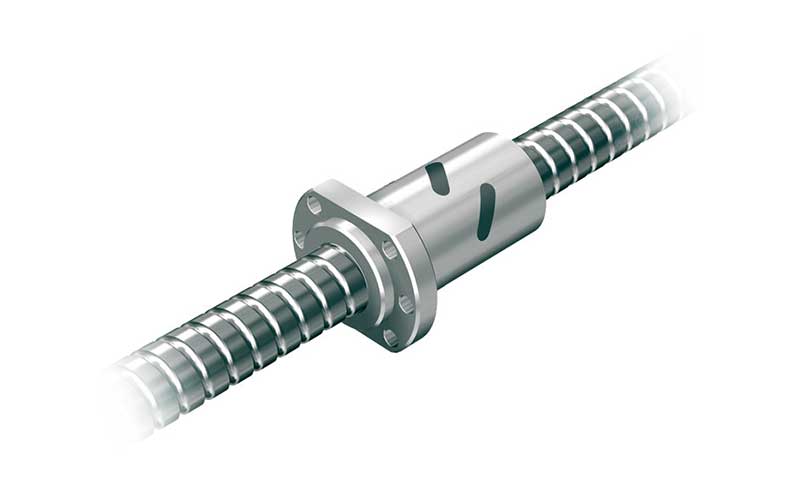
Ball screws compliant with ISO 3408 (DIN 69051)
Ball screws, manufactured according to the DIN standard, ensure high precision and efficiency in motion transfer. During operation, load-bearing balls slide between the screw shaft and nut absorbing the axial load; hence they are redirected through a groove with a deflector integrated into the nut, then reenter the adjacent track and return to the loaded area. This closed circuit allows the balls to perform a continuous rotary motion, reducing friction and wear.
Available preload methodologies:
- EBB: dimensional selection of balls (calibrated diameter)
- EPB: pitch offset between screw and nut
Available in P5 accuracy class, ideal for applications requiring high precision and repeatability.
Series HBN
Caged Ball Screw
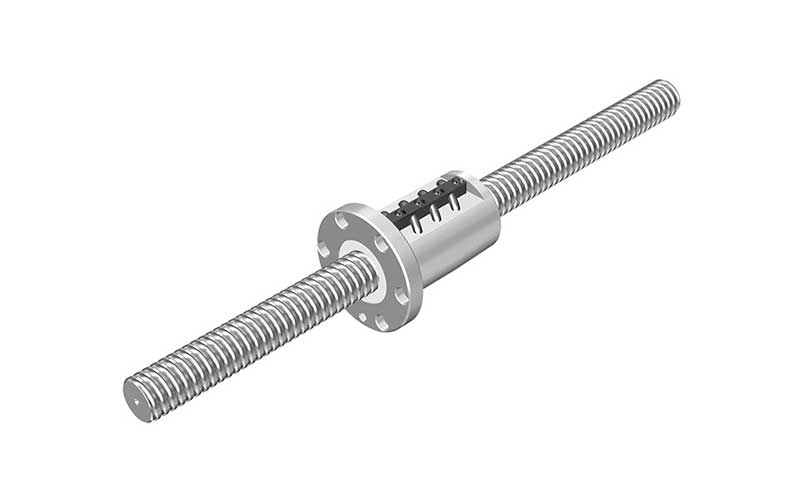
Ball screw for heavy loads – Model HBN with Caged Ball Technology
The HBN ball screw, designed for heavy loads, features an optimized internal structure that increases the nominal load capacity compared to traditional screws.
Main features:
- Ball retention cage: eliminates collisions and frictions, improving lubricant retention.
- Greater operational lifespan: extended lifetime with reduced noise and lower torque variation.
- Reinforced recirculation system: ball movement in an almost tangential direction, DN values up to 130,000.
- High performance: ideal for applications with high loads and intensive cycles.
- Reduced maintenance: longer maintenance intervals even with high-frequency use.
Series SBK/SBN
Caged Ball Screw
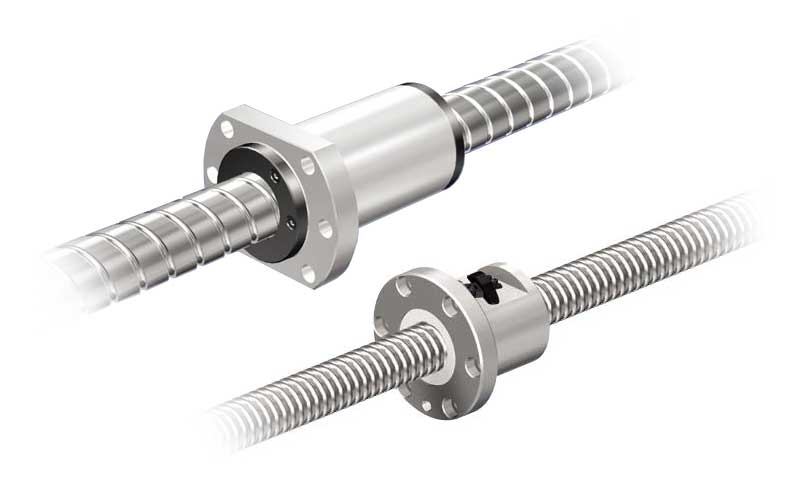
The caged ball screw with reinforced recirculation channel is designed to ensure high translation speeds.
The SBK version adopts a square pitch (pitch equal to the ball diameter) and allows speeds exceeding 2 m/s.
The high-speed SBN ball screw is equipped with caged ball technology, which eliminates collisions and friction between the balls and improves lubrication lifespan. This results in low noise, excellent torque characteristics, and long operating periods without maintenance.
Thanks to the reinforcement of the recirculation tube and the optimization of the tangential entry and exit of the balls, a DN value of 130,000 has been achieved. Moreover, the preload achieved through pitch offset at the center of the nut allows for a shorter and more compact nut compared to the double one, where the preload is instead generated with a central spacer.
In the high-speed SBK model, the balls are kept equidistant by a cage that eliminates collisions and frictions, ensuring high lubricant retention. The result is low noise, reduced oscillations at high speeds, and long-term maintenance-free operation. Additionally, the optimized recirculation structure, with exit from the thread and entry into the channel tangentially, permits achieving a DN value of 210,000.
Series BLR/DIR
Ball Screw
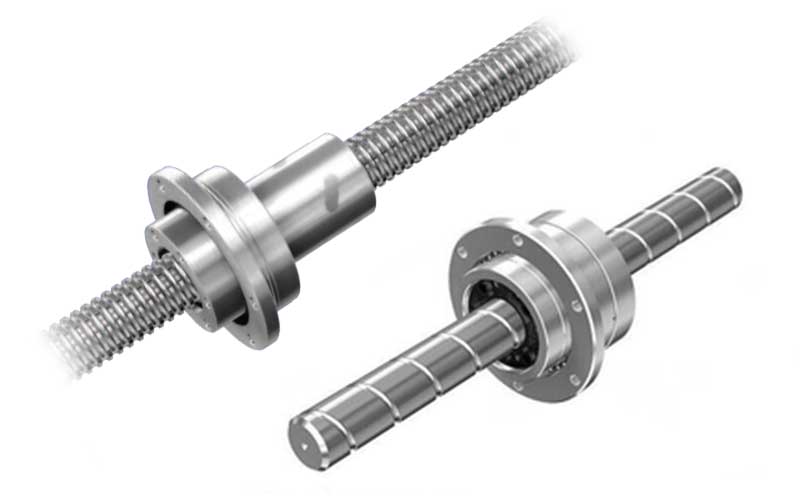
The BLR model is a ball screw unit where the recirculating nut is integrated with a supporting bearing. This is an angular bearing with a contact angle of 60°, which accommodates a large number of balls and ensures high axial rigidity. The BLR model is available in two versions: precision ball screw and rolled ball screw.
The DIR ball screw represents the standard version, featuring a structure that integrates a simple recirculating screw with a supporting bearing. In this model, the nut acts as a circulation mechanism via deflectors: balls travel along the groove of the deflector mounted in the nut, pass into the adjacent track, and return to the loading area, thus completing a continuous rolling cycle.
The preload in the DIR version is achieved through pitch offset, which provides multiple stages to the right and left threading at the center of the nut. This sets the axial transparency below zero (preload), allowing for a more compact and smooth movement compared to the traditional double nut type (which requires a central spacer).
The supporting bearing integrates two rows of angular bearings type DB with contact angle of 45°, ensuring the preload. Additionally, the pulley mounting collar is integrated directly into the ball screw nut.
Series BNS
Ball Screw
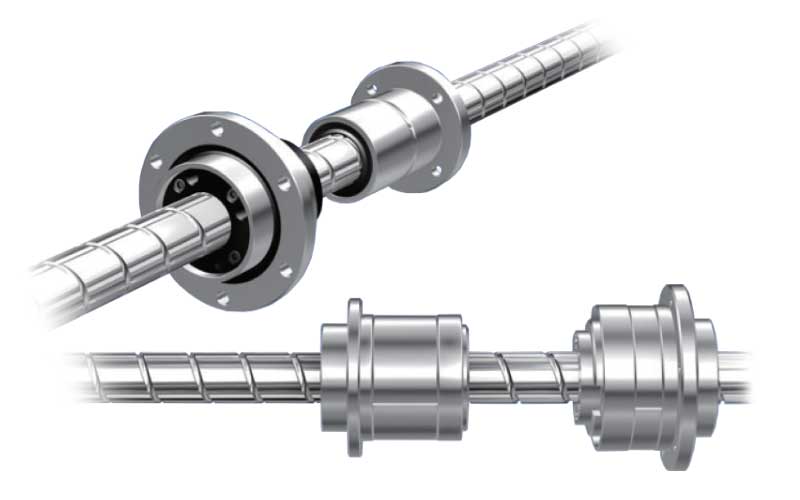
The unique screw model in the world combines the action of a ball screw with that of a grooved screw. Thanks to two nuts inserted on the screw, a rotary motion is achieved when the nuts move without relative rotation; in the presence of relative rotation, rotational-translational movements are generated.
Since the recirculating nut is integrated with a supporting bearing, the unit is extremely precise and compact. Moreover, the reduced inertia of the lightweight nut ensures high dynamics responsiveness.
The supporting bearing on the ball screw has a 60° contact angle on the axial direction, while that on the grooved screw adopts a 30° contact angle in the moment direction, thus guaranteeing a very rigid shaft support. A dedicated rubber sealing, provided as standard, prevents the ingress of foreign bodies. The ball screw is also easy to install: just fasten it to the housing using bolts (recommended internal diameter tolerance of housing: H7).
This system allows performing three movement modes with a single shaft:
- Rotary
- Linear
- Spiral
Thanks to these features, the system is particularly suitable for machines requiring combination of rotary and linear movements, such as the Z axis of SCARA robots, the assembly robots, automatic loaders, and ATC systems for machining centers.
Series SDA-V/SDAN-V
Ball Screw
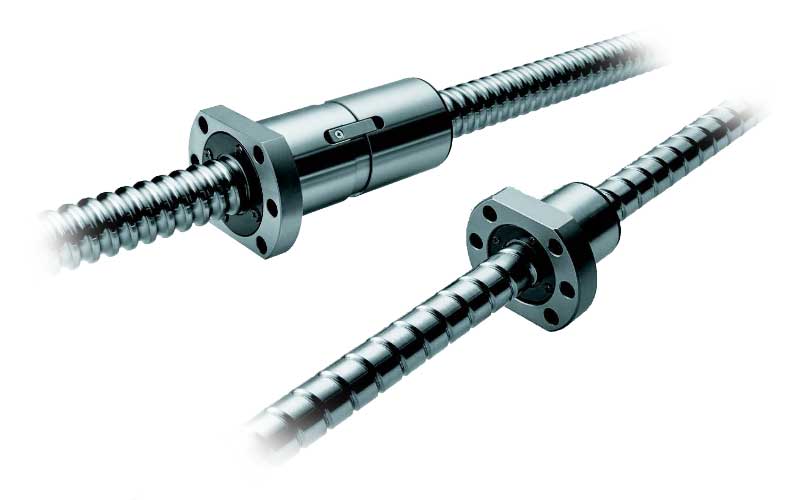
This screw model is designed to create compact high-speed machines, ensuring stable and reliable performance even under prolonged operating conditions.
The balls are guided in a tangential direction, allowing for maximum rotational speed of 5,000 min⁻¹ and a DN value of up to 160,000.
The torque remains stable even during long periods of high-speed operation, ensuring continuity and precision.
Newly designed recirculation components allow for an optimized recirculation structure, improving system efficiency and reducing vibrations and wear.
Nut dimensions comply with DIN 69051-5 standards, ensuring compatibility and ease of integration in existing designs.
Subscribe to the Newsletter
Product and service news, tips, and other benefits: it's worth subscribing!

Quick quote
Even if they aren't listed on our website, we probably have the spare parts you're looking for. Let us know the quantities and we'll send you our quote!