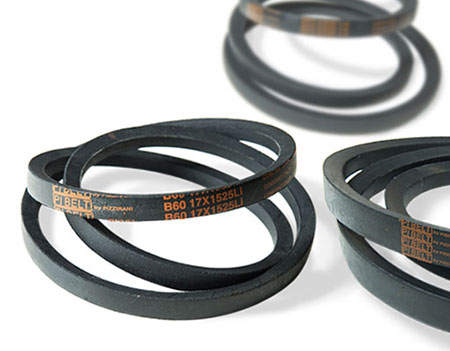
Industrial trapezoidal belts: power, safety, and long life
The industrial trapezoidal belts are designed for high-performance power transmission. Thanks to their function as a "mechanical fuse", in case of overload they allow controlled slipping that protects the kinematics and reduces the risk of failures.
Specifications and availability:
Metric trapezoidal belts, smooth or notched
Sections SPA, SPAX, SPB, SPBX, SPC, SPCX, SPZ, SPZX (metric) and A, AX, B, BX, C, CX, D, Z (inch) compatible with the respective pulleys
Metric and inch developments, with lengths up to over 15,000 mm
High-quality materials for reliability and long life
Ideal for industrial applications, machinery, and plants that require maximum efficiency and durability.
How to Calculate the Length (or Development) of a Trapezoidal Belt?
The length of the trapezoidal belt can usually be read directly from the stamping on it.
If the code on the belt cannot be read, for instance, due to wear, you can proceed to manual measurement and calculate the development according to the tables provided later.
It should be noted that for classic trapezoidal belts, the internal development is indicated as the standard reference, whereas for narrow trapezoidal belts, prefixed SP or XP, the primitive development is usually indicated.
To know the length of a belt, simply measure the EXTERNAL LENGTH manually, recording the measurement in millimeters, and then calculate the internal or primitive length based on the indications from the tables below.
After measuring the external length, which is usually easier and quicker to measure, simply subtract or add the values indicated in the table to the measured value in millimeters to obtain the actual development.
Trapezoidal Belts in Inches
Metric Trapezoidal Belts
Stamping of Trapezoidal Belts with Development Expressed in Inches
Stamping of Trapezoidal Belts with Development Expressed in Millimeters
Examples
1) I measure the external length of a belt with section Z.
To find the internal development, simply subtract 38 mm from the measured value.
2) I measure the external length of a belt with section SPB.
To find the primitive development, simply subtract 22 mm from the measured value.
Normally, for classic trapezoidal belts, the inch is used as the unit of measurement, but to simplify calculations, we preferred to indicate all measurements also in millimeters.
To practically measure the length of your belt, you can use a specific measuring tool, a tape measure, or more easily you can use a common piece of twine.
Remember that it is normal to have a margin of error of about 5 mm during manual measurement.
What is the difference between classic V-Belts (Z, A, B, C) and narrow V-Belts (SPZ, SPA, SPB, SPC)?
Classic V-Belts (sections Z, A, B, C, D, E) have a lower profile, while narrow V-Belts (sections SPZ, SPA, SPB, SPC) have a higher profile relative to width and allow for greater power transmission without increasing space requirements.
The indicative dimensions of the main sections are:
Classic: Z 10 × 6 mm, A 13 × 8 mm, B 17 × 11 mm, C 22 × 14 mm.
Narrow: SPZ 9.7 × 8 mm, SPA 12.7 × 10 mm, SPB 16.3 × 13 mm, SPC 22 × 18 mm.
On shop.atti.it, you can find over 3,300 V-Belts in various sections.
Consult the V-Belts category to identify the most suitable product for your application.
How is the designation of a V-Belt read (e.g., A 46 or SPB 5300)?
The designation of a V-Belt identifies the belt's section and its length.
In classic V-Belts, the number generally indicates the internal length expressed in inches. For example, a A 46 belt has an internal length of 46 inches, equivalent to 1,168.4 mm.
In narrow V-Belts, the number indicates the primitive length expressed in millimeters. For example, a SPB 5300 belt has a primitive length of 5,300 mm.
To identify a replacement belt, it is important to check the section and the number printed on the back of the belt.
You can consult the available products in the V-Belts category.
What does the X mean in V-Belts (AX, BX, XPZ, XPA)?
The letter X in the designation of a V-Belt generally indicates a version notched on the inner side, with cut sides.
Compared to smooth V-Belts, notched versions are more flexible, can operate on smaller diameter pulleys, and result in lower heat generation during operation.
The main notched sections are:
Classic: AX, BX, CX.
Narrow: XPZ, XPA, XPB, XPC, also referred to as SPZX, SPAX, SPBX, and SPCX.
ATTI offers notched V-Belts in various sections and lengths in the catalog to meet the requirements of industrial applications.
You can consult the products in the category V-Belts.
What is the difference between internal, primitive, and external development of a V-Belt?
The length of a V-Belt can be expressed in three ways:
Internal development (Li): it is the length measured along the inner side of the V-Belt.
Primitive development (Lp or Ld): it is the length measured along the reference line of the V-Belt, located between the inner and outer sides.
External development (La): it is the length measured along the outer back of the V-Belt.
The classic V-Belts are generally identified using the internal development, while the narrow V-Belts are identified using the primitive development.
When choosing a replacement V-Belt, it is important to check which type of development the measurement refers to, as the three values are not interchangeable.
On the product sheets of shop.atti.it, the type of length indicated is specified.
How do you measure a worn V-Belt if the code is no longer readable?
If the code of a V-Belt is illegible, you can identify it by measuring the section and the length.
First, measure the back width and the height of the belt to recognize its section. For example, a belt that is 13 mm wide and 8 mm high corresponds to section A.
Next, measure the external circumference using a flexible measuring tape or a string along the back of the belt.
To derive the reference length, you must apply the conversion value specified for the defined section. For example:
Section Z: subtract 38 mm from the external circumference to obtain the internal circumference.
Section SPB: subtract 22 mm from the external circumference to obtain the raw circumference.
You can consult the tables of sections and lengths on the V-Belts page.
Can I mount a Z-Belt on an SPZ pulley?
Generally yes. The pulleys for narrow V-Belts of sections SPZ, SPA, SPB, and SPC can also accommodate the classic belts of the corresponding sections Z, A, B, and C.
Reverse mounting, that is, fitting a narrow belt onto a pulley designed for a classic section, is not recommended, as the groove geometry is different.
Before replacing a belt with one of a different section, it is still important to check the transmission characteristics, particularly the power to be transmitted and the operating conditions.
To identify the most suitable solution, you can contact ATTI technical support.
In a drive with multiple grooves, should all V-Belts be replaced together?
Yes. When a drive uses multiple V-Belts in parallel, it is advisable to replace them all at the same time.
The belts must have the same actual length to properly distribute the load. Fitting a new belt alongside others that are already worn and stretched can lead to uneven stress distribution, resulting in premature wear.
For multiple drives, belt sets with reduced length tolerances are available, specially selected to work together.
You can consult the range in the category V-Belts.
Subscribe to the Newsletter
Product and service news, tips, and other benefits: it's worth subscribing!
Even if they aren't listed on our website, we probably have the spare parts you're looking for. Let us know the quantities and we'll send you our quote!